In February 2024, it was off to Bangkok from Frankfurt. The plan for this trip was to visit Kanchanaburi and Chiang Mai. I flew out on my own – my girlfriend, who lives in Thailand, came straight to Bangkok, and from there we carried on together.
The flight and getting into Bangkok
I searched for the flight the way I always do, via Momondo, then booked it through Expedia – €632 for myself alone, return. I drove my own car to Frankfurt and booked parking for the period 23 February to 7 March 2024 through Airparks, which cost €120.59. At the time, I had no idea that would still change – more on that at the end of Part 2.
Find comparable flights to Bangkok →
From Suvarnabhumi Airport, we took the Airport Rail Link into the city. The fare as far as Makkasan station, where we changed onto the metro, currently runs to 35 THB (around €1) per person – ride all the way to the terminus in the city centre and it's 45 THB these days. We switched to the MRT at Makkasan and carried on to Fai Chai station. From there it was a brisk twenty-minute walk to our accommodation, 24Residence Siriraj, which we'd booked through booking.com for €26 for two people for one night. We chose this place for a practical reason: it sits close to our next starting point, Thonburi railway station.
Riding the Death Railway to Kanchanaburi
A train journey from Thonburi Station in Bangkok to Nam Tok costs foreigners a flat 100 THB (around €2.60) in third class – regardless of distance. That price covers the entire length of the historic Death Railway, and tickets can only be bought on the day, straight from the counter at Thonburi. No advance booking, no booking online. I had absolutely no idea what to expect. Looking back, I'd happily do this trip again. But let's take it in order.
The official departure for Kanchanaburi is 07:45. Tickets are easy enough to get hold of on the spot, and there's no shortage of breakfast options either – right on the platform there's an Amazon coffee stand for anyone who finds it all a bit early. Across the road is a proper Thai market, where you can stock up on food and drink for the ride for next to nothing.
The train runs third-class carriages only. Depending on where you end up sitting, that means either a thinly padded bench or bare wood. The only air conditioning this train knows is the wind coming through the mostly open windows. If you're lucky, you'll get a seat near a fan – though there's no guarantee it works. Ours didn't, which was never really a problem: the breeze through the windows keeps you cool enough on its own. Some passengers lean their heads out of the window, or even hang out of the open doors while the train's moving – entirely at your own risk, and the train never picks up much speed. I wouldn't encourage anyone to try that particular stunt, though.
What stands out most, and what makes the ride so charming, is that at every stop locals climb aboard selling homemade treats. It's a great way to try traditional, handmade food and desserts. Up to Kanchanaburi, before the train crosses the legendary bridge over the River Kwai, the carriages are fairly empty. That changes in an instant, because everyone wants to experience the world-famous bridge and the railway itself. If you want to dig into the history, it's worth reading up on the Bridge on the River Kwai and the Burma Railway.
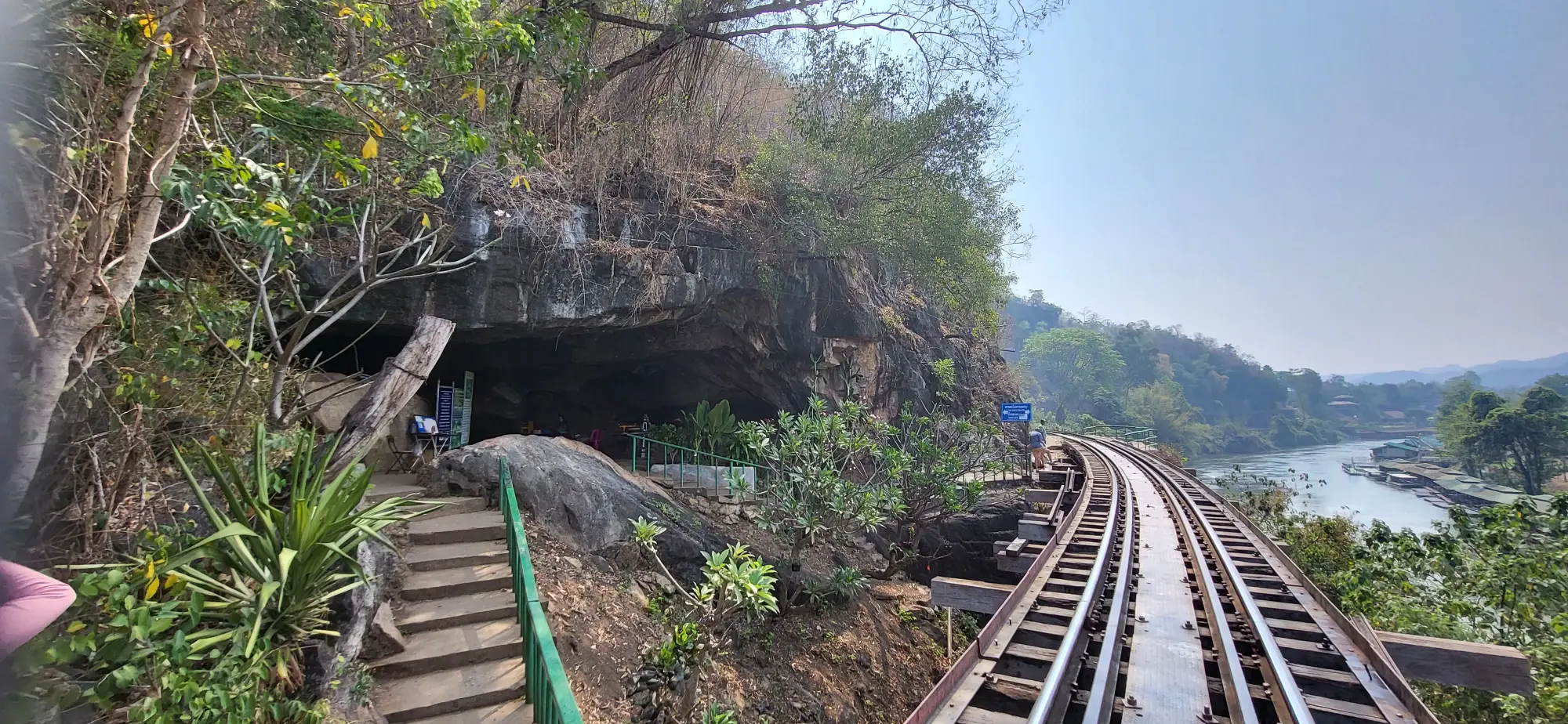
The closer you get to the final stop at Nam Tok, the more of an adventure the ride becomes. The train noticeably slows down, and the solid track bed gives way to wooden beams and trestles. At walking pace, the train crawls across these wooden bridges, creaking, groaning and cracking beneath you. Looking out of the window, you can practically touch the rock face the trestle clings to – the cliff was simply too massive for the builders to cut through, so they built the track hugging it instead, with the river on the other side. A thoroughly recommended experience, and remarkable value for money.
Arriving in Nam Tok, a local driver took us by car to our accommodation, the Binlha Raft Resort. It took barely fifteen minutes and cost us under 100 THB (around €3).
Check availability at Binlha Raft Resort →
Three nights on the River Kwai
We picked the Binlha Raft Resort because it has rooms right on the River Kwai. Firmly moored, but you could still feel the water flowing underneath – no seasickness involved. Three nights for two people came to €357.
Through the accommodation, we hired a scooter for three days, at 300 THB (around €8) a day. The next day we rode it out to the Srinagarind Dam – over an hour each way, which left our backsides thoroughly worked over and my right hand going numb again and again from holding the throttle at a steady angle. The dam itself wasn't anything spectacular.
The Erawan Falls, which we visited on the way back, absolutely were. It's a seven-tiered waterfall. When we visited in March 2024, entry cost 60 THB (around €1.60) for my Thai girlfriend and five times that for me as a foreigner, 300 THB (around €8) – just under €10 combined. Prices at parks like this can have gone up since, they do shift from time to time. We were there in early March, so during the dry season – the falls carried noticeably less water than they would in the rainy season. Still an easy recommendation.
A fish spa comes included at the falls: dangle your feet in one of the pools and small fish start nibbling at them. It doesn't hurt, though it did catch me off guard, since I wasn't expecting it. Sturdy footwear is an absolute must – you don't need hiking boots, but a decent pair of trainers is non-negotiable. The paths are well maintained, but you'll still cross the odd stretch of rock and root. Near the exit, before you leave the falls, there are a few shops to refuel with after all those calories burned.
Walking the Death Railway on foot
The next day took us straight back to the Death Railway – the stretch we'd ridden by train, we now wanted to experience on foot. We rode the scooter from our accommodation to Tham Krasae station, from where you can walk straight out onto the legendary wooden trestle section of the railway.
You barely need to worry about other trains: this stretch only sees two passenger trains a day, at fixed times, give or take the odd delay. We carried on a little further to the Krasae Cave before turning back – there's shade and a place to stop inside the cave. Even without trains, you need to keep your wits about you on the tracks themselves: it's a wooden structure with open gaps between the beams, and it's easy to twist an ankle if you're not paying attention. The walk itself is beautiful – you follow the river Kwai the whole way, with wide open nature and more floating accommodation dotted along the water.
The journey back to Bangkok
The next day it was time to say goodbye and head back towards Bangkok. From Nam Tok to Kanchanaburi bus terminal we took a taxi – the roughly 60-kilometre drive took about an hour and costs between 500 and 600 THB (around €13 to €16) today.
From Kanchanaburi Bus Terminal, we carried on to Bangkok by bus. Prices vary by operator and terminal – currently from €4 per person for the cheapest option, from €5 for other connections with a more direct arrival.
See bus connections Kanchanaburi–Bangkok →
We got off at Mo Chit Mini Bus Terminal, and since we had plenty of time, we walked the roughly three kilometres to Krung Thep Aphiwat Central Terminal Station on foot – free, and a good chance to catch our breath before heading on towards Chiang Mai.
What This Leg Cost
| Item | for | Price |
|---|---|---|
| Flight Frankfurt–Bangkok return, researched via Momondo, booked via Expedia | 1 person | €632.00 |
| Parking at Frankfurt Airport, 23 Feb–7 Mar 2024, via Airparks | 1 car | €120.59 |
| Airport Rail Link Suvarnabhumi–Makkasan, 35 THB p.p. | 2 people | around €2 |
| Accommodation Bangkok, 24Residence Siriraj, 1 night | 2 people | €26.00 |
| Train ticket Thonburi–Nam Tok (Death Railway, 3rd class), 100 THB p.p. | 2 people | around €5 |
| Driver Nam Tok–Binlha Raft Resort | 1 ride | around €3 |
| Accommodation Nam Tok, Binlha Raft Resort, 3 nights | 2 people | €357.00 |
| Scooter hire, 300 THB per day, 3 days | 1 scooter | around €24 |
| Erawan National Park entry (60 THB Thai / 300 THB foreigner, as of March 2024, may have risen since) | 2 people | just under €10 |
| Taxi Nam Tok–Kanchanaburi bus terminal | 1 ride | around €13–16 |
| Bus Kanchanaburi–Bangkok, from €4 p.p. (current price) | 2 people | from €8 |
All told, around €1,200. All amounts are given in euros; you pay in Thai baht on the ground, so the total shifts a little with the exchange rate. My girlfriend's own flight to Bangkok isn't included, since it isn't part of the route from Germany. A good half of that total is flight and parking alone – everything else, from the ride on the Death Railway to three nights on the River Kwai to the Erawan Falls, came to under €450 combined. That's exactly the point I keep making about deciding things individually: book an all-in package for this and you're paying for convenience, not for the experience itself.
All Booking Links at a Glance
- Flights: Expedia
- Parking Frankfurt: Airparks
- Accommodation Bangkok: 24Residence Siriraj
- Accommodation Nam Tok: Binlha Raft Resort
- Bus connections Kanchanaburi–Bangkok: 12Go
Part 2 of this trip carries on to Chiang Mai and back to Bangkok – that's also where I'll finally explain what happened with the parking.
And if reading this left you thinking "I'd love a trip like this, just without doing all the digging myself": that's exactly what I do. The first chat's on me.